
Get Relief for Your Sports Injury and Get Back in the Game!
Thomas was an avid high school soccer player with dreams of making it to the college level. He trained hard and played even harder, but one misstep during a match changed everything. As he lunged for the ball, he felt a sharp pain in his ankle and crumpled to the ground. The diagnosis was quick but disheartening: an ankle sprain.
Fortunately, at IMG Physical Therapy, our therapists are skilled at identifying and treating all types of sports injuries. Our therapists will conduct a whole-body assessment to ensure we identify all the factors that may impact recovery and design our programs tailored to the individual.
Give us a call today to learn more about our programs and set up an appointment with one of our physical therapists!
Identifying an Ankle Sprain
At first, Thomas didn’t know the severity of his injury. Like many, he thought he could just ‘walk it off.’ However, the key signs were there:
- Pain
- Swelling
- Difficulty putting weight on the foot
Ankle sprains occur when the ligaments that support the ankle stretch beyond their limits and tear. When Thomas landed awkwardly, he twisted his ankle in the process. Although ankle sprains are common in sports and often ignored, getting proper care is critical to quick recovery and reducing the risk of future injuries.
Unfortunately, too often, athletes don’t want to miss out on competing and “play through” injuries. Ankle sprains, in particular, are susceptible to recurrent sprains, especially when not properly rehabilitated.
The Road to Recovery
Thomas’s journey to recovery began with a visit to IMG Physical Therapy. He was evaluated by one of our skilled physical therapists and given guidance on how to recover quickly and get back into the game!
Initial Steps
Initially, Thomas’s therapy focused on reducing his pain, eliminating his swelling, and restoring his mobility. This involved:
- M.I.C.E (Move, Ice, Compression, Elevation): This simple method is crucial in the early stages of an ankle sprain. Thomas learned to keep moving his ankle, apply ice to reduce pain, and use compression with elevation to reduce the swelling.
Building Strength and Stability
Once the swelling reduced, Thomas’s therapy shifted gears towards rebuilding strength and stability. This phase included:
- Strengthening Exercises: Thomas worked on exercises to strengthen the muscles around his ankle. These included toe raises and resistance band exercises.
- Balance Training: To regain stability, Thomas practiced balancing exercises. This was crucial to prevent future sprains.
Regaining Functionality
The final phase of Thomas’s therapy centered on getting him back to his pre-injury level and back on the field. This involved:
- Functional Training: Thomas gradually returned to activities that mimicked soccer movements.
- Sport-Specific Drills: As he regained strength, sport-specific exercises were introduced to prepare him for returning to soccer.
Through his recovery, Thomas also learned how to perform sport-specific warm-ups, the importance of sleep, and regular conditioning to prevent injuries.
Embrace The Recovery Blueprint and Get Back in Action!
Thomas’s story is a reminder of the importance of addressing sports injuries with the guidance from our team at IMG Physical Therapy. Take the first step in healing your ankle sprain and returning to the sport you love by calling today to schedule an appointment!
Sources: https://www.ncbi.nlm.nih.gov/pmc/articles/PMC3103112/, https://pubmed.ncbi.nlm.nih.gov/29514819/, https://www.jospt.org/doi/10.2519/jospt.2021.0503
Hello All,
I hope everyone is having a great start to the spring season. I know I am looking forward to the warmer weather and the chance to get outside a little more and enjoy some of the activities that have not been as easy to get to in the winter, including playing soccer, trail hiking and running, biking, and of course tennis and pickle ball.

If you are like me, a weekend warrior who works 40 hours during the week and then likes to get out and be active over the weekend, sometimes injuries can occur.
Let’s be real: we’ve all been there. One minute you’re feeling like an MVP on the pickleball court or nailing your Saturday morning run, and the next—pop, twinge, or ouch. Suddenly, your weekend plans shift from the field to the couch with a bag of frozen peas. It’s frustrating, we get it. But an injury doesn’t have to mean “game over” for your season. Here’s the lowdown on how to handle those tweaks and get back to doing what you love.
The old school advice was to stay perfectly still until the pain went away. These days, we know better. While you shouldn’t be sprinting on a sprained ankle, total rest can actually make you stiffer.
Think of it as “relative rest.” If your knee is acting up, try some swimming or light walking. Keeping the blood flowing helps your body heal itself faster. The goal is to stay active without making the specific injury worse.
Most of us spend Monday through Friday hunched over a desk or steering wheel, then expect our bodies to go 0-to-100 on Saturday morning. That’s a recipe for a pull. Instead of a quick 30-second hamstring stretch, try to get your heart rate up for five minutes before you go full speed. A little bit of movement goes a long way in telling your muscles, “Hey, we’re about to do something athletic!”

Your body is great at giving you signals; we’re just really good at ignoring them.
- A dull ache? That’s a yellow light. Slow down, maybe ice it, and pay attention.
- Sharp, stabbing pain? That’s a red light. Pull over and take a break.
Pushing through “bad” pain usually just turns a one-week recovery into a three-month ordeal. Respect the signal!

You don’t need to be a pro athlete to see a PT. We’re basically mechanics for your body. We look at how you move to figure out why that shoulder keeps pinching or why your lower back gets tight after three holes of golf. Our goal isn’t just to stop the pain today—it’s to make sure you’re still playing twenty years from now. If that “tweak” from three weeks ago is still hanging around, it might be time for a professional tune-up. We’d love to help you get back to your weekend routine. Give us a call at IMG-PT and mention “Weekend Warrior” to get a trial of the Cold Laser, a $100 value!
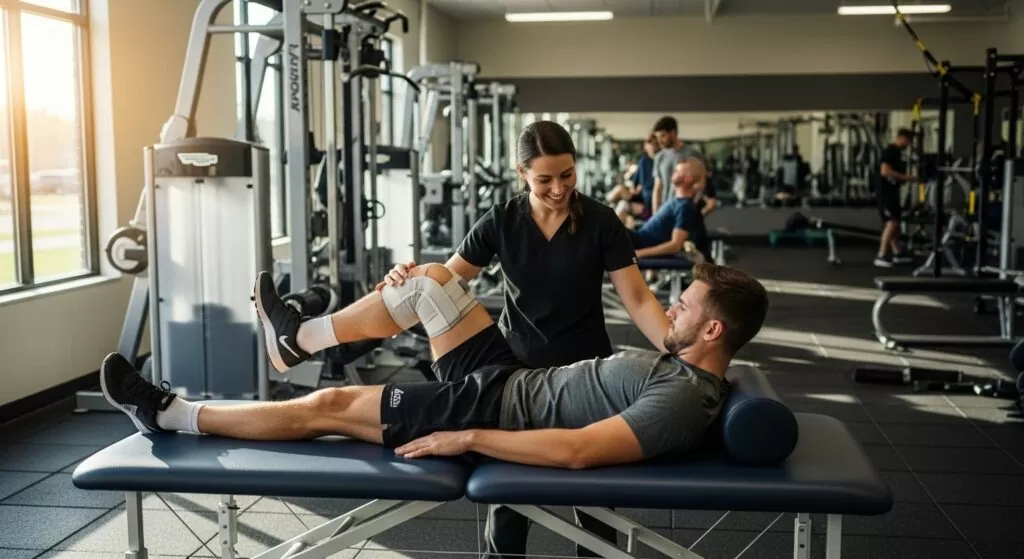
Why IMG Physical Therapy is the Key to Full Recovery After a Sports Injury
When recovering from a sports injury, time is of the essence, and seeing a physical therapist as soon as possible can be the pivotal factor that leads to a complete and successful rehabilitation. While many may consider these injuries a mere inconvenience, they can have long-lasting consequences if not treated properly from the start.
Here’s some of the common problems with waiting to see one of our physical therapists after a sports injury:
- Incomplete Healing: Ligaments and tissues may never regain their full strength and stability, leaving you vulnerable to further injuries. The longer you wait to address the issue, the more challenging it becomes to recover fully.
- Poor Rehabilitation: Inadequate or improper rehabilitation is a common pitfall that leads to recurrent injuries. Without proper rehabilitation, you risk weakening the supporting structures, setting the stage for another injury.
- Return to Activity Too Soon: One of the biggest mistakes an athlete can make is rushing back into physical activities or sports before a full recovery. It’s understandable to be eager to return to the game, but a premature return can lead to re-injury. Our physical therapists will guide you on when it’s safe to resume your activities, ensuring you don’t jeopardize your progress.
Your Road to Recovery Begins Now — Take Action Today!
When it comes to sports injuries, early intervention by one of our physical therapists is not just a wise choice — it’s a game-changer. Their expertise and guidance can make all the difference between a complete recovery and a cycle of recurrent injuries.
Don’t let an injury hold you back; call IMG Physical Therapy today. Your future self will thank you!

April 1, 2026
April Fool’s Day

April 5, 2026
Easter

April 15, 2026
Tax Day

April 22, 2026
Earth Day
Exercise of the Month
One Leg Balance
(Ankles, Core, Balance)
With your hands on the back of a chair, countertop, or wall, slowly lift your uninjured leg upward behind you so that your weight lies on the leg with the injured ankle. Hold this position for 20 to 30 seconds and gradually progress to more seconds as you get stronger. 2 Sets, 1 Rep. (Materials needed: chair)
Healthy Recipe: No Bake Vanilla Cheesecake

Ingredients:
- For the crust:
- 7 oz Shortbread cookies, finely crushed
- 6 tbsp Unsalted butter, melted
- For the filling:
- 1 1/4 cups Heavy cream
- 14 oz Full fat cream cheese
- 1/2 cup Powdered sugar, sifted
- 4 tsp Vanilla extract
Instructions:
Combine the finely crushed shortbread cookies with the melted butter and press into a tin. Chill in the fridge while you make the topping.
Pour the heavy cream into a bowl, add the cream cheese, powdered sugar and vanilla extract.
Whisk until it’s very thick – almost the consistency of ice cream. Use an electric whisk if you have one.
Remove the base from the fridge and add the cheesecake mixture, smoothing the top.
Pop into the fridge for at least 4 hours (or overnight is much better if you don’t need it until the next day).
Remove from the tin before serving.
Patient Spotlight
“The entire staff worked with me to make it a very productive experience. I learned many ways to increase my range of movement…from stretching my back to bending my knees. I am now able to walk with more agility and strength. I can ride my bicycle without my knees clicking anymore.”
—T.H.
Call Us Today
No matter your specific needs, IMG Physical Therapy is here to help you manage your symptoms. From personalized guidance to targeted exercise programs, we’ll find solutions that work for you.
Call us to schedule your initial consultation.