
How To Fix Improper Posture for Back and Neck Pain Relief
“Stand up straight!” has been a refrain from parents throughout the ages, but is it really that important? Actually – yes, it is!
Many people assume maintaining proper posture is about appearance: looking tall and confident. In reality, improper posture can cause pain in your neck and upper back and put pressure on your spine, leading to an increased injury risk.
But what exactly is proper posture? It probably won’t surprise you to learn that it’s more complicated than merely standing up straight. Instead, it’s more about finding the right spinal alignment for your body – and that’s something the physical therapists at IMG Physical Therapy can help you with!
If you’re struggling with persistent neck or back pain, it may be time to visit us for a postural assessment. We’ll help pinpoint any impairments or imbalances in your spine that might be causing problems and then provide strategies for maintaining your postural alignment throughout the day.
Call us to schedule an appointment for your initial consultation!
Understanding Proper Posture: Movement and Awareness is Key
Let’s get this out of the way first: There’s no universal “ideal posture” that will work for everyone. Even common advice like “stand up straight” isn’t particularly helpful: for one, no one’s spine is ever perfectly straight since it has a natural curve pattern. For another, you don’t spend your entire life standing still.
Rather than aiming for a non-existent “perfect” posture, you want to focus on two things:
- Postural Awareness: People don’t set out to have bad posture. You might start the day telling yourself you’re not going to slouch – but then, as you get busy with other tasks, posture becomes the last thing on your mind. By staying more aware of your posture, you can more easily adapt to the various positions you have to hold throughout the day.
- Avoid Prolonged Postures: Your body wants to move. Holding the same posture for extended periods (even if you’re sitting up straight and have everything in alignment) is still going to cause problems! Rather than aiming for a “perfect” posture, make sure to change your positions throughout the day. Alternate between sitting and standing. Switch positions. Get up and move around. In short – try to stay as active as possible.

Happy Memorial Day,
The saying goes: April showers bring May flowers. May also is the season for end of the school year activities: graduations, proms, and job searches for recent graduates. Often forgotten about May is the holiday we observe at the end of the month. Memorial Day, originally called Decoration Day, originated after the Civil War to honor fallen soldiers by decorating their graves. Established on May 30, 1868, by Gen. John A. Logan, it evolved from local tributes into a federal holiday observed on the last Monday in May to honor all American service members who died in war. For all those who may be reading this who have lost a family member, friend, or neighbor please be assured that they are in our thoughts and prayers, and we thank them and you for the ultimate price that they paid.
This is a great time to address a topic that comes up every week at the office and something that students, workers, and every American can think about starting to work on this summer to hopefully start the fall and winter seasons in better health. The topic is Posture and its Effects on Neck and Back Pain. Our culture, with the adoption of all technological devices, is creating a significant postural related epidemic. The constant looking down at our phone, work on computers, and sitting behind our desks has created “Tech neck” and significant low back related issues. The good news is that therapy can be of great benefit to help fix and even prevent these issues.
On our website we have a handout titled “The number one way we are killing our posture (cell phones).” Please visit our Prevention Exercise Program page and look for the title for the handout to pass onto your family and loved ones.
A great tip for back and neck related issues is for every 30-45 minutes you are on an electronic device to set a timer and when it goes off, change position or do a postural exercise to help prevent a pain related issue.
If the handout and this technique are not enough to help you with your pain, you may benefit from formal physical therapy. That would involve a complete evaluation, manual treatment, exercises, and possibly the cold laser treatment. You do not have to live with the pain and discomfort that poor posture has caused you or a loved one. Please give us a call and we will be happy to help you out.
Happy Memorial Day. Please have an amazing summer!!!!
The Relationship Between Posture and Pain
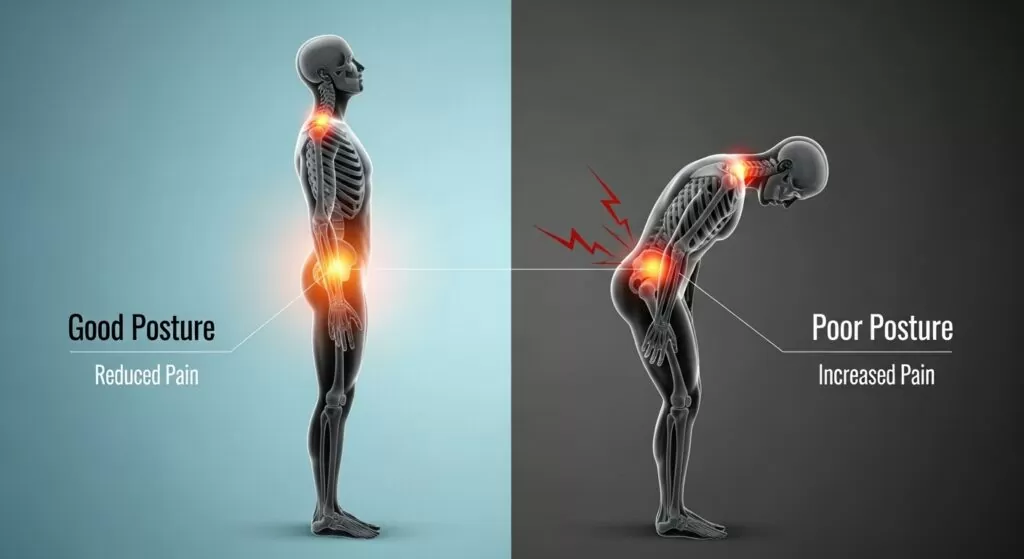
Neck and back pain have several potential causes and contributing factors. Improper posture is often one of them.
When you lose your postural awareness and start to slouch, it puts extra strain on the muscles that support your spine, particularly the muscles in your neck and upper back. This can lead to overuse injuries that cause pain or restricted mobility.
Remaining in prolonged postures (particularly sitting) also puts extra strain on your back muscles. When you get up and move around – even if it’s just for a few minutes – you relieve that pressure. Staying active also helps strengthen the muscles of your back and core, which helps prevent common musculoskeletal injuries that can cause pain and dysfunction.
Physical Therapy’s Role in Improving Posture
When you visit us for your appointment, here’s what we’ll do to help you improve your posture and reduce your back and neck pain:
- We start with a comprehensive postural assessment. We’ll take a look at your posture when you’re sitting, standing, and moving, looking for potential areas of dysfunction. We’ll also take a complete health history and might run some additional screens, too, testing for strength, mobility, balance, and more.
- We help with any acute pain. Manual therapy techniques and targeted mobility exercises can help relieve your pain and help you get your body’s function back.
- We help strengthen any weak muscles: Targeted strengthening exercises will help correct any muscular imbalances stemming from improper posture, providing better support and stability to your spine.
- We offer personalized postural corrections: The final piece of the puzzle helps ensure lasting relief. We’ll provide a customized postural improvement plan that speaks to your unique needs and impairments.
Start Improving Your Posture Today!
Fixing improper posture isn’t a one-and-done affair, but a visit to IMG Physical Therapy can help you get started. Call us to schedule your appointment today!
Sources: https://www.physio-pedia.com/Posture, https://www.ncbi.nlm.nih.gov/pmc/articles/PMC4499985/

May 4, 2026
Star Wars Day

May 10, 2026
Mother’s Day

May 16, 2026
Armed Forces Day

May 25, 2026
Memorial Day
Office Closed
Stealthy Exercises To Do At Your Work Desk
If you have an office job, it’s essential that you take breaks from sitting. Prolonged sitting strains our back and neck muscles, leading to pain and other impairments.
One way to combat this is to set a timer to go off every 30 minutes to an hour, reminding you to stop what you’re doing and take a few minutes to move: for instance, get up and walk around the office or do some simple stretches.
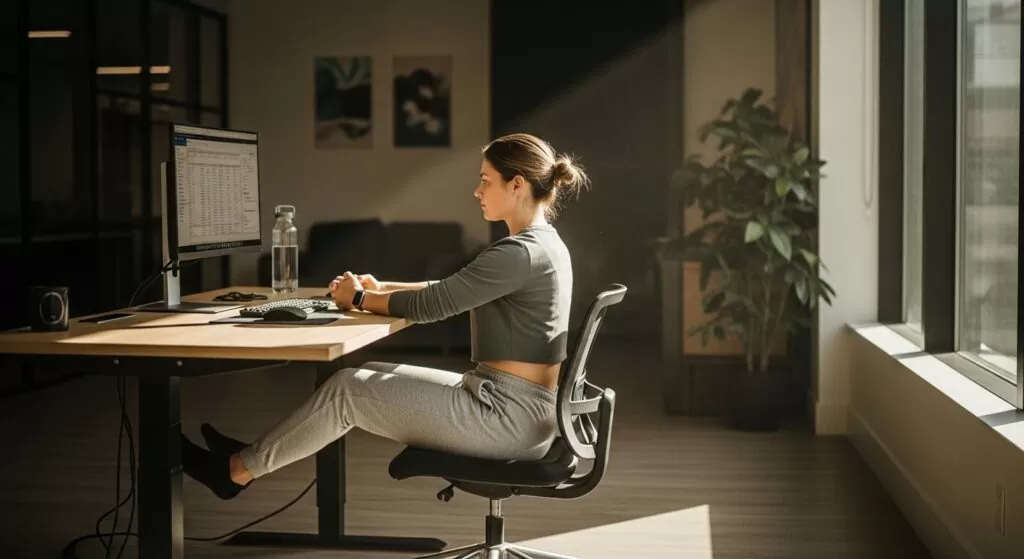
But sometimes, that’s just not possible. Fortunately, these stealth exercises allow you to work your core and back muscles without drawing a lot of attention to yourself.
- Core Activation: Sit up tall in your chair with your pelvis tilted forward. Squeeze your core muscles tightly and hold for 15 seconds (don’t forget to breathe). Then, release and repeat. You can build the intensity by lifting one foot at a time as you engage your core.
- Seated Twists: Sit up tall with your core activated. Take a deep breath in. Then, as you exhale, twist to one side. There, take five deep breaths, then return to facing the front. Repeat the process on the other side.
- Chair Squats: If you don’t need to be super-stealthy, chair squats are a good way to get some movement in. Push your chair away from your desk so you can stand up without using your hands. Then move to sit back down–but stop right before you hit the chair. Repeat as many times as you need.
Sources: https://www.cdc.gov/workplacehealthpromotion/initiatives/resource-center/pdf/Workplace-Physical-Activity-Break-Guide-508.pdf, https://www.ncbi.nlm.nih.gov/pmc/articles/PMC9162294/
Exercise of the Month
Seated Sciatic Nerve Tensioner
(Sciatic Nerve, Hamstrings)
Sit in a chair with one foot flat on the ground and the foot on the side you want to work, flexed with your toes pointing towards your face. Lift one lower leg by lightly contracting the upper thigh while simultaneously lowering your head, slowly tucking your chin towards your chest, and exhaling. Slowly return to the start. 3 Sets, 10 Reps. (Materials needed: chair)
Healthy Recipe: Reese’s Peanut Butter Cups
Once you make my irresistible Homemade Reese’s Peanut Butter Cups, you may never reach for that famous orange wrapper again! This ingenious recipe yields 20 candies bursting with chocolate peanut butter flavor. If you are a fan of store-bought peanut butter cups, try this easy, all-natural version for a healthier treat that’s even better than the original!

Ingredients:
- 2 cups milk chocolate, finely chopped
- ½ cup natural peanut butter, stirred
- 2 tablespoons almond flour
- 2 tablespoons maple syrup
- ⅛ teaspoon salt
Instructions:
Line a mini muffin tin with about 20 mini paper liners.
Melt the chocolate gently over a double boiler or in the microwave for about 90 seconds or until melted. Set aside.
Add about 2-3 teaspoons of chocolate to each liner and using a small spoon, spread the chocolate up the sides of the cups. Refrigerate or freeze for 10-15 minutes until set.
In a small bowl, combine the peanut butter, almond flour, maple syrup and salt until combined.
Scoop about 1 ½-2 teaspoons of peanut butter mix into each cup. Dampen your finger and pat down to filling to create an even layer.
Top each cup with about 3 teaspoons of the remaining melted chocolate to completely cover the peanut butter. Use a spoon to smooth out the tops.
Return to the refrigerator for about 1 hour to set, then store at room temperature in an airtight container for up to 2 days or in the fridge for up to 3 weeks.
Patient Spotlight
“I’m feeling great after several weeks of PT. Prior to beginning therapy I had significant shoulder pain when sleeping. I also experienced discomfort and reduced strength when performing general household tasks. Keyboarding is a large part of my job and I had significant pain after a couple of hours working at a computer. All of these activities feel fine now. The largest benefit is improved sleep. Everyone I worked with at IMG-PT was wonderful.”
—C.L.
Call Us Today
No matter your specific needs, IMG Physical Therapy is here to help you manage your symptoms. From personalized guidance to targeted exercise programs, we’ll find solutions that work for you.
Call us to schedule your initial consultation.